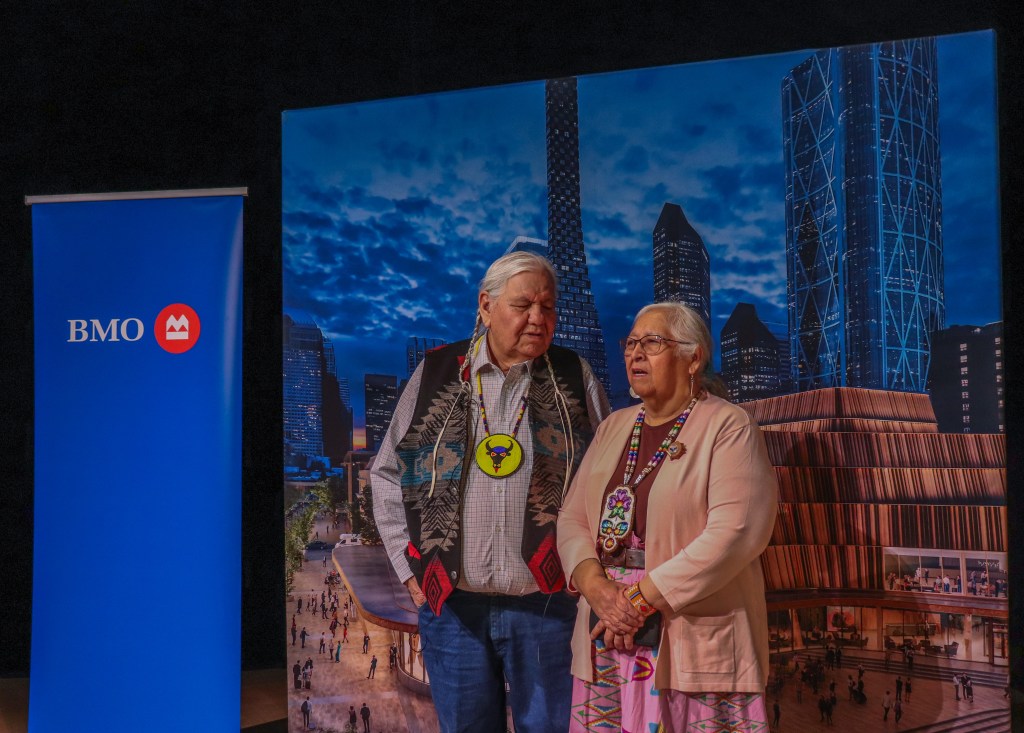
Arts Commons | 18m | 4s | City of Calgary | KPMB

You feel this random lobby furniture arrangement is somehow connecting the larger community with indigenous heritage?
If you didn't read the article, that's fine but this isn't a lobby furniture arrangement.

My point wasn't that it is good enough and we can move on, it was that it isn't my place to say what is good enough. If these indigenous people feel like they're being taken advantage of with "check the box" inclusion, I think they would stand up and say this isn't good enough. If they are not and some feel that way, then they need to have their voice heard too. I believe there was a donation or funding included in the announcement, so there was at least more than symbolism.

Does this give BMO a "White Saviour" complex because they did this, and now they feel like they've written all their wrongs? Maybe but then again, they are doing more than people saying, "we should do more" and then they don't do anything.

This form of reconciliation is performative, so what, it is valuable to say what you're doing sometimes rather than just doing it because it brings awareness to what some part of the design might mean. Sometimes you have to say Pink Elephant for people to see the Pink Elephant. If you or other people don't feel like this is good enough and that it is performative then don't just say something, do something. But I'm not sure that's what you're saying...

It's the forced elements into everyday life and literally every civic project, when the vast, vast majority of Canadians have no indigenous heritage.
I think it is acknowledging the first people that were here. That's what reconciliation is, saying, "we see you". I might misunderstand as you could mean this is appropriation of their culture but then again, I think they would say, "you're just using us".

This is a development forum, so comment away but if you're saying this isn't good enough, then you have to do more than just say it. Maybe if you have an indigenous person in your life, ask them how they feel?

I want to have this conversation; it is important that we can talk about it but if you feel that way, do something about it. I'm a white guy who has tried to learn about all this but I'm not perfect, I'm a little uncomfortable writing this because of that and I try not to be a white saviour but just try to say it isn't my place to say when enough is enough.
 
Last edited:
I agree mostly with your perspective. But I think expecting indigenous people to speak up even if they feel performative is unlikely. Especially when some are clearly benefiting from this and it's usually the ones with the voice (business leaders, chiefs, spiritual leaders, etc.)

It's unfortunate what's happened with indigenous relations in this country. I believe the vast majority, but relatively silent group don't want the Gladue principle (just put more criminals back into their community), land claims over the lower mainland or these reconciliation lodge/room/artwork that they will never get to see or use. They want drinking water, safe schools, business and employment opportunities. Unfortunately in any of these groups, there's always a few that can check the box and uses it enrich themselves, whether it's using their heritage to make money from corporations/reconciliation industry, diverting funds to their friends away from infrastructure projects , or making incredibly unpopular land claims to get compensation, with many dollars not flowing to those in need. And anytime there is any criticism, the using their indigenous heritage as a shield. It's turned a lot of people (not sure if it's majority or not) against the idea of reconciliation, and it's unfortunate.
 
I want to have this conversation; it is important that we can talk about it but if you feel that way, do something about it. I'm a white guy who has tried to learn about all this but I'm not perfect, I'm a little uncomfortable writing this because of that and I try not to be a white saviour but just try to say it isn't my place to say when enough is enough.
I think this is the part that bothers me the most. We now have these "arbitrary rules" about who can or cant have an opinion because you "werent effected". It's 2026, the vast, vast majority havent been directly effected. If it's none of by business, then why is it be forced into the public realm to the level that it is. Historical harms, unfortunately, are in every country. You can't keep relitigating the past. Germany does not have "Jewish" design consultations with bridges and libraries...the US does not have indigenous or african american design standards for their arenas and theatres. We seem to be on an island in the world for the lengths we will go to to "right a wrong"...that seemingly knows no end. Whereas the solution I think the majority of us can get behind is ensuring every remote indigenous community has access to modern basic necessities like clean water, electricity, high speed internet, transportation connections, affordable food.
 
I think this is the part that bothers me the most. We now have these "arbitrary rules" about who can or cant have an opinion because you "werent effected". It's 2026, the vast, vast majority havent been directly effected. If it's none of by business, then why is it be forced into the public realm to the level that it is. Historical harms, unfortunately, are in every country. You can't keep relitigating the past. Germany does not have "Jewish" design consultations with bridges and libraries...the US does not have indigenous or african american design standards for their arenas and theatres. We seem to be on an island in the world for the lengths we will go to to "right a wrong"...that seemingly knows no end. Whereas the solution I think the majority of us can get behind is ensuring every remote indigenous community has access to modern basic necessities like clean water, electricity, high speed internet, transportation connections, affordable food.
They may not have a Jewish design consultant, but it's a criminal offence to deny the holocaust in Germany. Canada is certainly not the only country reconciling for their past mistakes.

Land acknowledgements and indigenous design elements may sound arbitrary, but as mentioned before, it brings constant reminders and awareness that we are on their land and the indignities that their people suffered in the past. History gets lost overtime and a part of reconciliation is to ensure that what happened is not forgotten or rewritten for the comfort of the present day.

You can also provide basic necessities to indigenous communities, while also preserving and celebrating their culture that lasts generations and brings pride to their people. It does not need to be one or the other.
 
I think this is the part that bothers me the most. We now have these "arbitrary rules" about who can or cant have an opinion because you "werent effected". It's 2026, the vast, vast majority havent been directly effected. If it's none of by business, then why is it be forced into the public realm to the level that it is. Historical harms, unfortunately, are in every country. You can't keep relitigating the past. Germany does not have "Jewish" design consultations with bridges and libraries...the US does not have indigenous or african american design standards for their arenas and theatres. We seem to be on an island in the world for the lengths we will go to to "right a wrong"...that seemingly knows no end. Whereas the solution I think the majority of us can get behind is ensuring every remote indigenous community has access to modern basic necessities like clean water, electricity, high speed internet, transportation connections, affordable food.
I don't think you realize how much it costs to deliver clean water, electricity, high speed internet, transportation connections and affordable food to all these often remote communities, often with relatively low economic capacity. Many reserves are in the state they are because there's few industries and very little fiscal capacity. Highways cost in the hundreds of millions. Water treatment plants require skilled workers, potentially millions of replacement pipes from the new facility to people's homes. It's far easier to say you've "done the work" and name a section of a funded building the "BMO lodge" than it is to fund a highway or roads.
 

As an aside, "ethical gathering space" is a new one. I love these sorts of corporate euphemisms and this one is a delight. Perhaps the old Olympic Plaza was an unethical gathering space, pre-redevelopment?
"The BMO lodge is our physical manifestation of a commitment to open space where people can gather on their terms"

....otherwise known as a lobby
 
I think this is the part that bothers me the most. We now have these "arbitrary rules" about who can or cant have an opinion because you "werent effected". It's 2026, the vast, vast majority havent been directly effected. If it's none of by business, then why is it be forced into the public realm to the level that it is. Historical harms, unfortunately, are in every country. You can't keep relitigating the past. Germany does not have "Jewish" design consultations with bridges and libraries...the US does not have indigenous or african american design standards for their arenas and theatres. We seem to be on an island in the world for the lengths we will go to to "right a wrong"...that seemingly knows no end. Whereas the solution I think the majority of us can get behind is ensuring every remote indigenous community has access to modern basic necessities like clean water, electricity, high speed internet, transportation connections, affordable food.
Canada has indigenous design standards for our arenas and theaters? Is this in the building code or a CSA standard?
 
Canada has indigenous design standards for our arenas and theaters? Is this in the building code or a CSA standard?
I was using design "standards/consultations/requirements" words interchangeably to mean the same thing, to make the point that any public sector project now has this element baked in
 
I was using design "standards/consultations/requirements" words interchangeably to mean the same thing, to make the point that any public sector project now has this element baked in
Ok, I think that's a pretty important distinction. You feel EVERY public sector project has it baked in, others reading it given the other language used, may think we actually have a code requiring it. Also, there is an implication it adds cost all the time, that sometimes isn't true at all.
 

Back
Top